
For many, myself included, Steven Spielberg is the filmmaker who made us fall in love with cinema. Few directors have effortlessly moved between genres. He reinvented the summer blockbuster with Jaws and Raiders of the Lost Ark, made harrowing historical dramas such as Schindler’s List and Saving Private Ryan, andchanged the way we look at extraterrestrials with E.T. and Close Encounters of the Third Kind. I’ve made no secret of my attachment to Spielberg; without him, there’s a good chance I wouldn’t be writing this review. There’s also a chance this very website wouldn’t exist.
Disclosure Day finds the Oscar-winning filmmaker once again tackling aliens, this time through a much more modern lens. It also marks his first summer release in a decade, returning him to the time of year he once ruled at the multiplex. UAP (Unidentified Anomalous Phenomena) disclosure has become an increasingly hot topic in recent years, from Barack Obama casually chatting about the existence of aliens on a podcast to the current administration releasing more files about potential unidentified phenomena. With the conversation only growing louder, now feels like the perfect time for Spielberg to return to the topic alongside his longtime collaborator David Koepp.
What Is ‘Disclosure Day’ About?
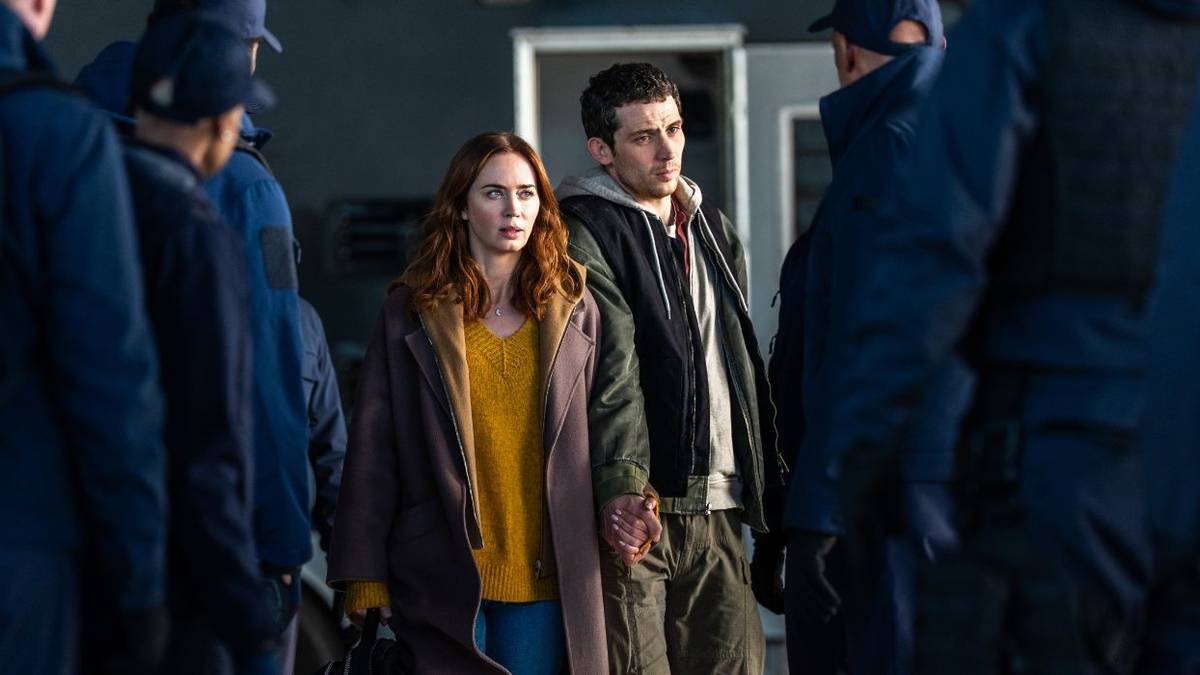
Humanity is on the brink of World War III, and civilians all around the world are glued to newscasts and phone screens anxiously awaiting updates on the escalating global conflict. But that’s not what Daniel Kellner (Josh O’Connor) is interested in. Recently released from prison for cybercrimes, Daniel was recruited by a secret organization known as Wardex, run by the eccentric Noah Scanlon (Colin Firth). At the start of the film, we meet Daniel after he has fled the organization, having discovered that Wardex is hiding the existence of extraterrestrial life from the rest of the world. Are these aliens friendly? Well, that’s for you to find out. Now, Daniel is on the run alongside his girlfriend, Jane (Eve Hewson), a former nun, while working alongside fellow whistleblower Hugo Wakefield (Colman Domingo).
Margaret Fairchild (Emily Blunt) is a TV meteorologist in Kansas City trapped in a crumbling relationship with Jackson (Wyatt Russell), an aspiring musician. Her life has never been the same since a strange childhood experience left her with abilities that have recently been activated. While trying her hardest to understand what is happening, Margaret can seemingly read people’s minds and speak in different languages and dialects at will, though it is a power she can’t control, as we see when she begins speaking in strange alien gibberish during a live weather report. A large chunk of Disclosure Day follows Daniel and Margaret on separate journeys as they race to uncover the truth while being pursued by Noah. They don’t know each other — at least not personally — but Hugo believes that their shared experiences and knowledge may be the key to making disclosure possible.
‘Disclosure Day’ Is Closer to ‘Minority Report’ Than ‘E.T.’
Disclosure Day isn’t the movie you think it’s going to be. The marketing has been shrouded in secrecy, with many even speculating that it could be a stealth sequel to Close Encounters of the Third Kind or E.T., but that isn’t what Spielberg’s latest turns out to be. There are clear shades of Close Encounters throughout, but Disclosure Day is more in conversation with films like Minority Report and A.I. Artificial Intelligence, with a surprising splash of the Indiana Jones franchise thrown in for good measure.
At its core, Disclosure Day is a modern-day conspiracy thriller that isn’t afraid to tackle themes of surveillance, free will, and spirituality. Even with a nearly two-and-a-half-hour runtime, Spielberg nails the pacing; his knack for creating that indescribable sense of wonder is felt throughout. A chase sequence in the second act involving O’Connor and Hewson’s characters is as immersive as it is invigorating. As strong as that set piece is, the film’s most effective sequence comes in the third act, building to a breathtaking and immensely satisfying conclusion. Koepp’s script shares more in common with some of his recent work, including Black Bag and Presence, in the way it finds humanity within elevated, uncanny situations.
10 Movies That Steven Spielberg Wants You To See
Few recommendations carry more weight than one from Spielberg.
Spielberg’s longtime DP Janusz Kamiński delivers brilliant camerawork, particularly in the way it incorporates the movie’s visual effects. One of the most impressive shots arrives at an unexpected moment, as Blunt’s Margaret stares into a hospital window and her face overlaps with a man on the other side. It is scenes like this that keep the momentum going; Spielberg never tires of leaving moviegoers in awe. Kamiński’s cinematography also finds clever ways to display Margaret’s powers, as we watch her seamlessly become other people.
Another Spielberg stalwart, John Williams, returns to compose the score for Disclosure Day, delivering one of his best in decades. Spielberg and Williams have always brought out the best in each other, and that is once again the case here. Williams’ score fits comfortably alongside some of his early work with Spielberg, elevating the emotion, suspense, and spectacle of the story.
Emily Blunt Delivers a Career-Best Performance in ‘Disclosure Day’

Blunt has always been an exceptional actress, and much like Spielberg, she has moved between genres with remarkable ease. Her performance in Disclosure Day may just be her finest work to date. It isn’t only the way she portrays Margaret’s emotional journey, though she excels at that; her most impressive feat is how believably she sells Margaret’s powers. Blunt can switch between accents, tones, and languages with such ease, and it never once feels outlandish. It is intentionally jarring, a difficult task for any performer, but Blunt pulls it off beautifully.
O’Connor, continuing his movie star momentum, also turns in strong work as Daniel — a character who, like the protagonists in Jaws and Close Encounters, isn’t your typical blockbuster hero. He’s neither hyper-charismatic nor overly distant, instead serving as a bridge between Blunt and the rest of the cast. Domingo, Hewson, and Russell are also given their own standout moments, with the former two delivering dialogue that avoids becoming too expository and the latter serving as the comedic relief. Meanwhile, Firth’s performance as Noah gives off energy better suited for a villainous role in an Indiana Jones movie. His performance is committed, but there are moments when it feels like he’s in a completely different movie from everyone else.
Disclosure Day is not going to be everybody’s cup of tea. It finds Spielberg blending elements of some of his more recent work, such as Bridge of Spies, with the spectacle of Close Encounters and Minority Report, and much like A.I., it isn’t afraid to get a little weird. But this is a summer blockbuster made for cinephiles, with no IP attachment and no overreliance on obvious Easter eggs. Even if you aren’t entirely in awe of what Spielberg and Koepp have cooked up, there is still plenty to be impressed by. As a Spielberg devotee, Disclosure Day gave me exactly what I wanted from his return to the alien movie.
Disclosure Day opens in theaters on June 12.